E-Invoicing in MENA Beyond Saudi Arabia: Egypt's Universal Phase, UAE's 2026 Mandate, and the QR Layer Across the Regional Rolloutالفوترة الإلكترونيّة في الشرق الأوسط بعد السعوديّة: المرحلة الشاملة في مصر، الإلزام الإماراتي ٢٠٢٦، وطبقة QR عبر التطبيق الإقليمي
Saudi Arabia's ZATCA Phase 2 (covered in detail in our earlier piece) was the first wave. The regional wave is now larger: Egypt's ETA universal-phase rollout is hitting every VAT-registered company through 2026, UAE's FTA mandatory e-invoicing begins for VAT-registered businesses in 2026, Bahrain and Kuwait are in consultation, and Iraq is exploring frameworks. Each country uses a different regulator, a different invoice format, a different QR encoding, and a different clearance model — but they all share one structural feature: a QR code on every issued invoice that contains the regulator-verifiable hash of the invoice payload. This is the cross-country playbook: how ZATCA, ETA, and FTA differ in their QR specification; what the technical migration path looks like for B2B companies operating across multiple MENA countries; the integration patterns with the underlying e-invoicing platforms; the timeline through 2027; and the eight mistakes that turn an e-invoicing rollout into a regulatory penalty.كانت المرحلة الثانية من ZATCA في السعوديّة (المغطّاة بالتفصيل في مقالنا السابق) الموجة الأولى. الموجة الإقليميّة الآن أكبر: إطلاق المرحلة الشاملة لمصلحة الضرائب المصريّة يطال كلّ شركة مسجَّلة في ضريبة القيمة المضافة خلال ٢٠٢٦، الفوترة الإلكترونيّة الإلزاميّة للهيئة الاتّحاديّة للضرائب في الإمارات تبدأ للشركات المسجَّلة في ضريبة القيمة المضافة في ٢٠٢٦، البحرين والكويت في مرحلة التشاور، والعراق يستكشف الأطر. كلّ دولة تستخدم جهة تنظيميّة مختلفة، صيغة فاتورة مختلفة، ترميز QR مختلف، ونموذج تخليص مختلف — لكنّ جميعها تشترك في خاصّيّة بنيويّة واحدة: رمز QR على كلّ فاتورة مُصدَرة يحوي تجزئة بيانات الفاتورة القابلة للتحقّق من المنظّم. هذا هو كتالوج التطبيق عبر الدول: كيف تختلف ZATCA وETA وFTA في مواصفات QR؛ كيف يبدو مسار الهجرة التقني للشركات B2B التي تعمل عبر عدّة دول في الشرق الأوسط؛ أنماط التكامل مع منصّات الفوترة الإلكترونيّة الأساسيّة؛ الجدول الزمني خلال ٢٠٢٧؛ والأخطاء الثمانية التي تحوّل إطلاق الفوترة الإلكترونيّة إلى عقوبة تنظيميّة.
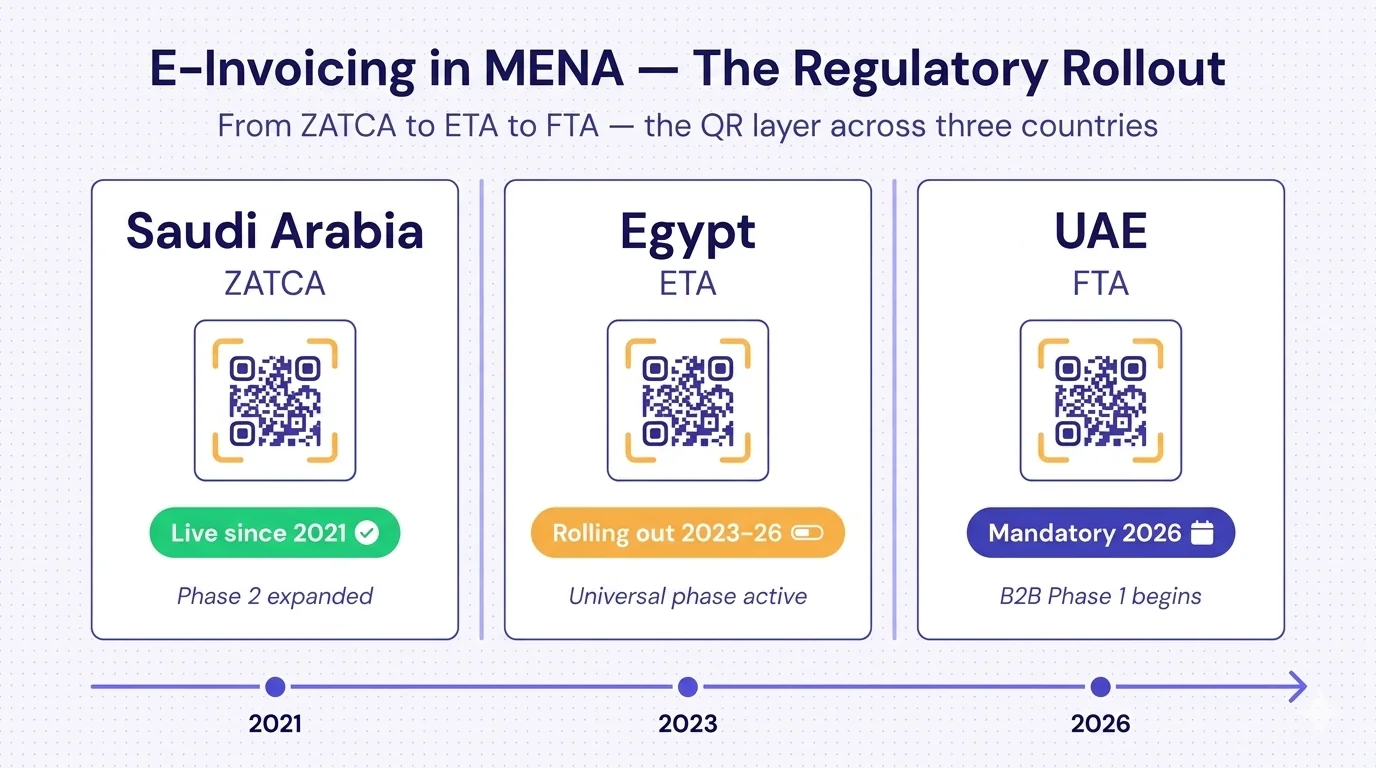
Saudi Arabia's ZATCA Phase 2 e-invoicing rollout, which we covered in our ZATCA Phase 2 piece, was the first wave of mandatory e-invoicing in MENA. It is no longer the only wave. Egypt's universal-phase rollout is currently in progress, sweeping through every VAT-registered company across the country; the UAE's FTA mandatory e-invoicing for VAT-registered businesses begins in 2026; Bahrain and Kuwait are in active regulatory consultation with frameworks expected within the same window; Iraq is exploring CTC-model adoption. By the end of 2027, every major MENA economy will operate a mandatory e-invoicing regime. Each one will use a regulator-specified QR code on every issued invoice as the universal trust anchor between issuer, recipient, and the tax authority.
This piece is the cross-country regulatory playbook for the MENA e-invoicing wave beyond Saudi Arabia. It covers how ZATCA, ETA (Egypt's Tax Authority), and FTA (UAE Federal Tax Authority) differ in their QR specifications and clearance models, what the technical migration path looks like for a B2B company operating across two or three of these countries simultaneously, the integration patterns with the underlying e-invoicing platforms, the firm-and-tentative timelines through 2027, and the eight mistakes that turn an e-invoicing rollout into a regulatory penalty. The framing matters: e-invoicing is the single biggest B2B-commerce regulatory event in MENA in the 2020s, and the QR layer is structurally embedded in every implementation.
Why MENA is rolling out e-invoicing in waves
E-invoicing is a global trend, not a MENA-specific one. The driving force is tax-authority revenue protection: when invoices are issued only on paper or as unstructured PDFs, the tax authority cannot verify whether VAT is being correctly assessed, charged, and remitted. Mandatory e-invoicing — where every invoice must be issued in a structured digital format AND validated against the tax authority's systems before being delivered to the recipient — closes the gap. The world precedents (Italy 2019, Mexico 2014, Brazil long-established, Chile, Poland 2024, Romania, France 2026, Germany 2026) all converge on a CTC (Continuous Transaction Control) or clearance model where every invoice is checked in real-time or near-real-time by the tax authority.
MENA is following the same playbook on a compressed timeline. Saudi Arabia adopted aggressively in 2021-22 with ZATCA Phase 1 (issuance) and Phase 2 (integration and clearance). Egypt began rolling out in 2020, expanded through 2022-23, and is now in the universal phase that completes coverage. UAE was slower to start but is now moving — FTA's e-invoicing decision came in 2024, with mandatory rollout starting 2026 for VAT-registered businesses. Other GCC countries are following. The pattern is that the QR code on the invoice is the universal trust anchor: scannable, verifiable against the regulator's registry, embedded in every output.
How the three regulators differ: ZATCA, ETA, FTA at a glance
Saudi Arabia — ZATCA (live since 2021)
Model: clearance-on-issuance. Every invoice is sent to ZATCA's Fatoora platform for cryptographic stamping and validation before it can be considered legally issued. Format: a structured XML (UBL 2.1 with Saudi extensions) for the digital invoice, with a human-readable PDF/A-3 version generated that embeds the XML and the ZATCA-returned cryptographic stamp. QR specification: a TLV (Tag-Length-Value) encoded QR containing seller name, VAT number, timestamp, invoice total, VAT amount, ZATCA cryptographic stamp, signature, and certificate hash. The QR is mandatory on every B2C invoice from Phase 1 and on every B2B invoice from Phase 2. Coverage: Phase 2 reached the smallest VAT-registered businesses through 2024-25; full universal coverage as of 2026. Our ZATCA Phase 2 piece covers the QR's structure and rendering requirements.
Egypt — ETA (rolling out 2020-2026)
Model: clearance-on-issuance, similar to ZATCA but with different platform mechanics. Every invoice goes through Egypt's Tax Authority's e-invoicing platform for validation. Format: a structured XML (proprietary ETA schema, not UBL — a notable divergence from ZATCA), with a PDF representation including the QR. QR specification: a JSON-encoded QR (different from ZATCA's TLV) containing the invoice UUID, the ETA-issued reference number, the issuer tax number, the recipient tax number, the invoice total, the VAT, the timestamp, and a verification URL pointing to ETA's invoice-validation page. The QR's scan opens the ETA verification page on ETA's domain — distinct from ZATCA's pattern where the QR is decoded locally for offline verification. Coverage: phased rollout through annual industry waves, completing universal coverage in 2026. Currently, every VAT-registered B2B company in Egypt is in scope; B2C is in extension.
UAE — FTA (begins 2026)
Model: 5-corner CTC model (resembling Mexico, Italy, and France 2026) — invoices flow through accredited service providers (the 'corner-4 nodes') who route to the FTA and to the recipient. Different from ZATCA's direct-to-regulator model. Format: structured XML based on the international PEPPOL BIS Billing 3.0 specification (NOT UBL extensions like ZATCA, NOT proprietary like ETA — a third format choice that aligns with European pattern). QR specification: announced 2024-25 with full technical specification through 2025; expected to follow PEPPOL conventions with a verification URL embedded. Coverage: Phase 1 for large VAT-registered businesses begins 2026, expanding through 2027 to smaller businesses. Phase B2C considered for 2027 onward but not yet announced.
What this means for B2B companies operating across multiple MENA countries
A company billing customers in Saudi Arabia, Egypt, and UAE — common for regional service providers, large retailers, IT companies, consultancies — must satisfy all three regulators simultaneously by 2026-27. This is harder than 'just print the QR' because each regulator has a different format, a different platform integration, a different clearance model, and a different invoice-state lifecycle. The migration path:
- Inventory current invoice issuance per country and the tax-status of each customer. A Saudi customer needs a ZATCA-compliant invoice; an Egyptian customer needs an ETA-compliant one; a UAE customer (post-2026) needs an FTA-compliant one.
- Adopt an e-invoicing platform that supports all three (or contract with accredited service providers in each country). The major regional ERP vendors (SAP, Oracle, Microsoft Dynamics, NetSuite) all have country-specific connectors in 2025-26; specialised e-invoicing-only platforms (Pagero, EDICOM, Avalara, Sovos) have multi-country support.
- Implement the QR-generation pipeline on the invoice output. For each country: the right format encoded into the QR, the right regulator-returned cryptographic stamp embedded, the right size and placement on the PDF.
- Test invoice-clearance with each regulator's sandbox/test environment before going live. ZATCA sandbox is mature; ETA sandbox is functional but documentation lags; FTA sandbox is still being finalised in 2025.
- Train accounting, finance, and IT teams on each country's clearance flow. Common failure mode: the team is trained on ZATCA but the Egypt invoices are rejected because the team didn't realise ETA has different rules.
- Monitor compliance per country on an ongoing basis. Each regulator publishes updates; missed updates result in rejected invoices and tax-authority penalties.
The QR-on-invoice common pattern across all three
Despite the format and platform differences, there's a common pattern in what the QR DOES on a MENA e-invoice. Every regulator's QR contains:
- An identifier for the issuing party (VAT registration number or equivalent tax ID).
- An identifier for the receiving party (VAT registration number if B2B, omitted or anonymised if B2C).
- The invoice-total amount and the VAT amount.
- A timestamp of issuance.
- A cryptographic hash or stamp that the regulator can validate as authentic against their registry.
- (For ETA and likely FTA) — a verification URL pointing to the regulator's invoice-lookup page where the recipient can confirm authenticity by scanning.
The structural function is the same: the QR is the trust anchor between issuer, recipient, and regulator. Anyone holding the printed/PDF invoice can scan and verify it. The recipient's accounting team can confirm legitimacy before processing payment. The tax authority can perform real-time audits. Fraud detection happens at the network level rather than during periodic manual audits.
MENA e-invoicing timeline through 2027
- Q1 2026 — Egypt: completion of universal-phase rollout, all VAT-registered businesses in scope including the smallest taxpayers.
- Q2 2026 — UAE: FTA Phase 1 mandatory e-invoicing begins for largest VAT-registered businesses (turnover thresholds to be confirmed in late-2025 FTA publications).
- Mid-2026 — Bahrain: regulatory framework expected to be finalised and published by NBR (National Bureau for Revenue); mandatory rollout 2027.
- Late 2026 — Kuwait: e-invoicing framework consultation expected to conclude; mandatory rollout 2027-28.
- 2026 — Oman: VAT-system maturation expected to enable e-invoicing framework consultation.
- 2027 — Qatar: e-invoicing under active consideration by the GTA (General Tax Authority); framework rollout possible by 2028.
- 2027 — Iraq: framework consultation; rollout dependent on broader tax-system modernisation.
- 2027 — Jordan, Lebanon, Morocco, Tunisia, Algeria: regional alignment expected to drive framework consultation across the broader region.
The timeline is partly firm (Egypt 2026, UAE 2026 are confirmed) and partly anticipated (Bahrain, Kuwait, Oman, Qatar, Iraq dates depend on framework finalisations). The direction is unambiguous: by 2028 every major MENA economy will operate mandatory e-invoicing, and the QR-on-invoice will be the structural commonality across all of them.
How this connects to QR Code platform choices
A company implementing MENA e-invoicing across multiple countries needs a QR-rendering layer that can produce the country-specific QR formats correctly. Most ERP vendors handle the basic format generation (the TLV for ZATCA, JSON for ETA, PEPPOL for FTA), but the practical work falls into three categories where a specialised QR platform adds value:
- Rendering: the QR has to print correctly at the right size on the PDF, with the right error-correction level, with the right contrast for the tax-authority's scan-verification to work. The detail in our iPhone-vs-Android decoder piece applies — the regulator's verification tool needs to scan the QR reliably, which means it must be high-contrast and properly sized.
- Audit logging: every QR generated for compliance purposes must have an audit log entry — when issued, on which invoice, with which payload, against which regulator. This is a data-retention obligation that lives alongside the e-invoicing flow itself.
- Multi-country routing: a single B2B company might issue 1,000 invoices a month split across three MENA countries. The QR layer needs to route each to the right country's specification automatically based on the customer's country of registration.
Eight mistakes that turn e-invoicing into a regulatory penalty
- Using a single QR specification across multiple countries. ZATCA and ETA QRs are mutually incompatible — a Saudi customer receiving an ETA-format QR cannot verify it; an Egyptian customer receiving a ZATCA-format QR cannot verify it.
- Generating the QR locally without the regulator's cryptographic stamp embedded. The QR can be 'visually correct' but reject during validation. The cryptographic round-trip with the regulator is mandatory.
- Sizing the QR too small or in a low-contrast colour. Tax-authority scan tools may fail to read it, leading to invoice-rejection alerts. Standard is 25mm × 25mm minimum, high-contrast black-on-white.
- Embedding the QR as a low-res raster image. Each tax authority's compliance-validation tools may reject below-threshold images. Use vector embedding into the PDF.
- Failing to update QR generation when the regulator updates the specification. Egypt and UAE specifically are publishing iterative updates through 2026; out-of-date QRs are non-compliant.
- Treating the QR as cosmetic / optional. It is mandatory. Invoices without the regulator-spec QR are treated as un-issued for legal/tax purposes. Customer payments may be refused; tax authority may impose penalties.
- Not testing in each country's sandbox before live rollout. ZATCA sandbox, ETA sandbox, FTA sandbox (when available) each must be exercised. Testing only in ZATCA and assuming Egypt/UAE will behave the same is the most common failure pattern.
- Storing the QR-data payload as a regular field in the ERP without encryption or access control. The QR contains the invoice's cryptographic stamp, which has audit value — treat it as a security-sensitive data element.
How QRA fits into a multi-country e-invoicing workflow
QRA's role in a MENA-wide e-invoicing rollout is the QR-rendering and audit-logging layer that connects the ERP's invoice-generation logic to the country-specific QR format requirements. The platform accepts the regulator-returned cryptographic payload (TLV from ZATCA, JSON from ETA, PEPPOL-derived from FTA) and emits a correctly-formatted, high-contrast, vector-embedded QR for the invoice PDF — with audit logging of every generation event. For multi-country B2B companies, this means one QR-generation API integrated into the ERP, with automatic routing to the country-specific specification based on customer registration. The dynamic-QR backbone (every QR's metadata is editable and traceable from the dashboard) provides the audit-grade traceability that the tax authority audit teams require. Data residency is honoured on a per-country basis — ZATCA invoices' audit logs are hosted in Saudi-region infrastructure; ETA invoices' audit logs are hosted in Egypt-region infrastructure; FTA invoices in UAE-region. Multi-country, audit-grade, regulator-compliant — three structural properties that bare-bones QR generators don't address.
The short answer
MENA e-invoicing is a wave that began with Saudi Arabia's ZATCA in 2021 and is now expanding across the region. Egypt's ETA is in active universal-phase rollout through 2026. UAE's FTA mandatory e-invoicing begins 2026 for VAT-registered businesses. Bahrain, Kuwait, Oman, Qatar, Iraq follow on 2027-28 timelines. Each regulator uses a different invoice format, a different clearance model, and a different QR specification — but every implementation embeds a QR on every invoice as the universal trust anchor. B2B companies operating across multiple MENA countries need to satisfy all relevant specifications simultaneously: country-specific QR formats, regulator-returned cryptographic stamps, audit-grade logging, in-jurisdiction data residency. The QR-on-invoice is no longer optional; it's the structural commonality across the entire regional wave. Plan for multi-country compliance early — the cost of retrofitting is significantly higher than building it correctly from the start.
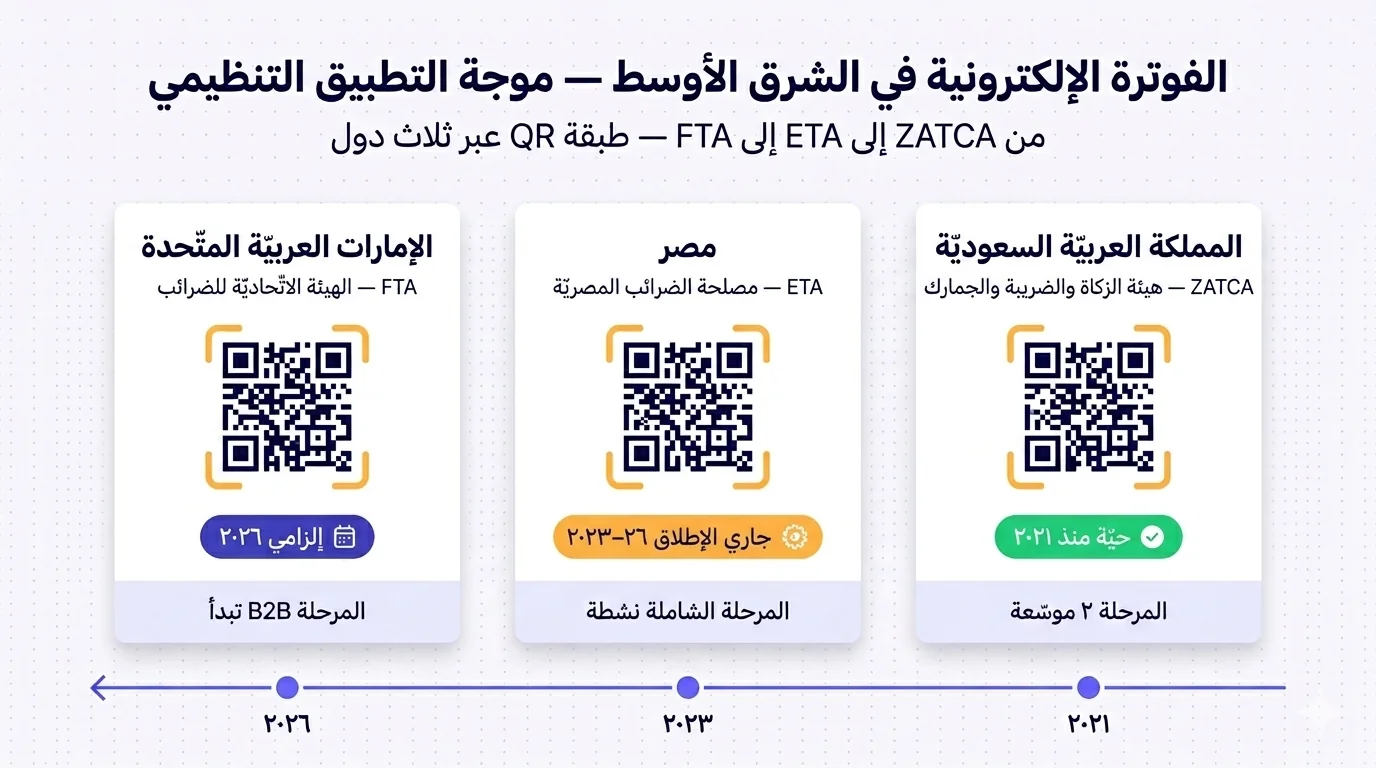
كانت إطلاق المرحلة الثانية من ZATCA للفوترة الإلكترونيّة في السعوديّة، التي غطّيناها في مقالنا عن ZATCA المرحلة ٢، الموجة الأولى من الفوترة الإلكترونيّة الإلزاميّة في الشرق الأوسط. لم تعد الموجة الوحيدة. إطلاق المرحلة الشاملة لمصلحة الضرائب المصريّة قيد التنفيذ حاليّاً، يمتدّ عبر كلّ شركة مسجَّلة في ضريبة القيمة المضافة في البلاد؛ الفوترة الإلكترونيّة الإلزاميّة للهيئة الاتّحاديّة للضرائب في الإمارات للشركات المسجَّلة في ضريبة القيمة المضافة تبدأ ٢٠٢٦؛ البحرين والكويت في تشاور تنظيمي نشط مع أطر متوقّعة ضمن النافذة نفسها؛ العراق يستكشف تبنّي نموذج التحكّم بالمعاملات المستمرّ (CTC). بنهاية ٢٠٢٧، كلّ اقتصاد رئيسي في الشرق الأوسط سيشغّل نظام فوترة إلكترونيّة إلزامي. كلّ واحد منها سيستخدم رمز QR محدّداً من المنظّم على كلّ فاتورة مُصدَرة كمرتكز الثقة العالمي بين المُصدِر، المستلم، والجهة الضريبيّة.
هذا المقال هو الكتالوج التنظيمي عبر الدول لموجة الفوترة الإلكترونيّة في الشرق الأوسط ما بعد السعوديّة. يغطّي كيف تختلف ZATCA وETA (الجهة الضريبيّة المصريّة) وFTA (الهيئة الاتّحاديّة للضرائب الإماراتيّة) في مواصفات QR ونماذج التخليص، كيف يبدو مسار الهجرة التقني لشركة B2B تعمل عبر دولتين أو ثلاث في وقت واحد، أنماط التكامل مع منصّات الفوترة الإلكترونيّة الأساسيّة، الجداول الزمنيّة المؤكّدة والمتوقّعة حتّى ٢٠٢٧، والأخطاء الثمانية التي تحوّل إطلاق الفوترة الإلكترونيّة إلى عقوبة تنظيميّة. الإطار مهمّ: الفوترة الإلكترونيّة هي أكبر حدث تنظيمي للتجارة B2B في الشرق الأوسط في عقد ٢٠٢٠، وطبقة QR مدمجة بنيويّاً في كلّ تطبيق.
لماذا تطبّق منطقتنا الفوترة الإلكترونيّة على شكل موجات
الفوترة الإلكترونيّة اتّجاه عالمي، لا خاصّ بمنطقتنا. القوّة الدافعة هي حماية إيرادات الجهة الضريبيّة: حين تُصدَر الفواتير فقط على ورق أو كـPDF غير مهيكلة، لا تستطيع الجهة الضريبيّة التحقّق هل ضريبة القيمة المضافة قُيِّمت، فُرضت، وحُوِّلت بشكل صحيح. الفوترة الإلكترونيّة الإلزاميّة — حيث يجب إصدار كلّ فاتورة بصيغة رقميّة مهيكلة والتحقّق منها مقابل أنظمة الجهة الضريبيّة قبل تسليمها للمستلم — تُغلق هذه الفجوة. السوابق العالميّة (إيطاليا ٢٠١٩، المكسيك ٢٠١٤، البرازيل المرسَّخة منذ زمن، تشيلي، بولندا ٢٠٢٤، رومانيا، فرنسا ٢٠٢٦، ألمانيا ٢٠٢٦) كلّها تتقارب على نموذج CTC أو نموذج تخليص حيث تُفحَص كلّ فاتورة في الوقت الحقيقي أو القريب منه بواسطة الجهة الضريبيّة.
منطقتنا تتّبع الكتالوج نفسه على جدول زمني مضغوط. تبنّت السعوديّة بقوّة في ٢٠٢١-٢٢ مع المرحلة ١ من ZATCA (الإصدار) والمرحلة ٢ (التكامل والتخليص). بدأت مصر الإطلاق في ٢٠٢٠، توسّعت خلال ٢٠٢٢-٢٣، والآن في المرحلة الشاملة التي تكمل التغطية. الإمارات كانت أبطأ في البدء لكنّها الآن تتحرّك — قرار FTA بشأن الفوترة الإلكترونيّة جاء في ٢٠٢٤، مع إطلاق إلزامي يبدأ ٢٠٢٦ للشركات المسجَّلة في ضريبة القيمة المضافة. دول الخليج الأخرى تتبع. النمط هو أنّ رمز QR على الفاتورة هو مرتكز الثقة العالمي: قابل للمسح، قابل للتحقّق مقابل سجلّ المنظّم، مدمج في كلّ مخرج.
كيف تختلف الجهات التنظيميّة الثلاث: ZATCA وETA وFTA في لمحة
السعوديّة — ZATCA (حيّة منذ ٢٠٢١)
النموذج: تخليص-عند-الإصدار. كلّ فاتورة تُرسَل إلى منصّة فاتورة في ZATCA للختم التشفيري والتحقّق قبل أن تُعتبَر صادرة قانونيّاً. الصيغة: XML مهيكلة (UBL 2.1 مع امتدادات سعوديّة) للفاتورة الرقميّة، مع نسخة PDF/A-3 قابلة للقراءة البشريّة تضمّن XML والختم التشفيري الذي يرجعه ZATCA. مواصفات QR: رمز مُشفَّر بـTLV (وسم-طول-قيمة) يحوي اسم البائع، الرقم الضريبي، الطابع الزمني، إجمالي الفاتورة، مبلغ ضريبة القيمة المضافة، الختم التشفيري من ZATCA، التوقيع، وتجزئة الشهادة. الرمز إلزامي على كلّ فاتورة B2C من المرحلة ١ وعلى كلّ فاتورة B2B من المرحلة ٢. التغطية: المرحلة ٢ وصلت إلى أصغر الشركات المسجَّلة في ضريبة القيمة المضافة خلال ٢٠٢٤-٢٥؛ تغطية شاملة كاملة اعتباراً من ٢٠٢٦. مقالنا عن ZATCA المرحلة ٢ يغطّي بنية الرمز ومتطلّبات العرض.
مصر — ETA (جاري الإطلاق ٢٠٢٠-٢٠٢٦)
النموذج: تخليص-عند-الإصدار، مماثل لـZATCA لكن بميكانيكا منصّة مختلفة. كلّ فاتورة تمرّ عبر منصّة الفوترة الإلكترونيّة لمصلحة الضرائب المصريّة للتحقّق. الصيغة: XML مهيكلة (مخطّط ETA الخاصّ، لا UBL — تباعد ملحوظ عن ZATCA)، مع تمثيل PDF يحوي الرمز. مواصفات QR: رمز مُشفَّر بـJSON (مختلف عن TLV في ZATCA) يحوي UUID الفاتورة، الرقم المرجعي الصادر عن ETA، الرقم الضريبي للمُصدِر، الرقم الضريبي للمستلم، إجمالي الفاتورة، ضريبة القيمة المضافة، الطابع الزمني، ورابط تحقّق يشير إلى صفحة التحقّق من الفواتير في ETA. مسح الرمز يفتح صفحة التحقّق في ETA على نطاق ETA — مختلف عن نمط ZATCA حيث يُفكّ تشفير الرمز محلّيّاً للتحقّق دون اتّصال. التغطية: إطلاق على مراحل عبر موجات صناعيّة سنويّة، يكتمل بتغطية شاملة في ٢٠٢٦. حاليّاً، كلّ شركة B2B مسجَّلة في ضريبة القيمة المضافة في مصر ضمن النطاق؛ B2C في التوسيع.
الإمارات — FTA (تبدأ ٢٠٢٦)
النموذج: نموذج CTC بخمس زوايا (يشبه المكسيك، إيطاليا، وفرنسا ٢٠٢٦) — الفواتير تتدفّق عبر مزوّدي خدمة معتمَدين (عقد الزاوية ٤) الذين يوجّهون إلى FTA وإلى المستلم. مختلف عن نموذج ZATCA المباشر إلى المنظّم. الصيغة: XML مهيكلة قائمة على مواصفات PEPPOL BIS Billing 3.0 الدوليّة (ليست امتدادات UBL مثل ZATCA، ولا خاصّة مثل ETA — خيار صيغة ثالث يتماشى مع النمط الأوروبي). مواصفات QR: أُعلنت ٢٠٢٤-٢٥ مع المواصفات التقنيّة الكاملة خلال ٢٠٢٥؛ يُتوقَّع أن تتبع اتّفاقيّات PEPPOL مع رابط تحقّق مُضمَّن. التغطية: المرحلة ١ للشركات الكبرى المسجَّلة في ضريبة القيمة المضافة تبدأ ٢٠٢٦، تتوسّع خلال ٢٠٢٧ إلى الشركات الأصغر. مرحلة B2C قيد الدراسة لـ٢٠٢٧ فما بعد لكنّها لم تُعلَن بعد.
ما يعنيه هذا للشركات B2B العاملة عبر عدّة دول في الشرق الأوسط
شركة تفوتر عملاء في السعوديّة، مصر، والإمارات — شائع لمزوّدي الخدمات الإقليميّين، تجّار التجزئة الكبار، شركات تقنيّة المعلومات، الاستشارات — يجب أن تلبّي الجهات التنظيميّة الثلاث في وقت واحد بحلول ٢٠٢٦-٢٧. هذا أصعب من «اطبع الرمز فقط» لأنّ لكلّ منظّم صيغة مختلفة، تكامل منصّة مختلف، نموذج تخليص مختلف، ودورة حياة حالة فاتورة مختلفة. مسار الهجرة:
- جرد إصدار الفواتير الحالي لكلّ دولة والوضع الضريبي لكلّ عميل. عميل سعودي يحتاج فاتورة متوافقة مع ZATCA؛ عميل مصري يحتاج فاتورة متوافقة مع ETA؛ عميل إماراتي (ما بعد ٢٠٢٦) يحتاج فاتورة متوافقة مع FTA.
- تبنَّ منصّة فوترة إلكترونيّة تدعم الثلاث (أو تعاقد مع مزوّدي خدمة معتمَدين في كلّ دولة). موزّعو ERP الإقليميّون الكبار (SAP، Oracle، Microsoft Dynamics، NetSuite) جميعهم لديهم موصّلات خاصّة بالدولة في ٢٠٢٥-٢٦؛ منصّات الفوترة الإلكترونيّة المتخصّصة (Pagero، EDICOM، Avalara، Sovos) لديها دعم متعدّد الدول.
- طبّق مسار توليد QR على مخرج الفاتورة. لكلّ دولة: الصيغة الصحيحة مُشفَّرة في الرمز، الختم التشفيري الذي يرجعه المنظّم مُضمَّناً، الحجم والموضع الصحيح على PDF.
- اختبر تخليص الفواتير مع بيئة الاختبار/الرملي لكلّ منظّم قبل الإطلاق المباشر. بيئة اختبار ZATCA ناضجة؛ بيئة اختبار ETA تعمل لكنّ التوثيق متأخّر؛ بيئة اختبار FTA لا تزال قيد الإنهاء في ٢٠٢٥.
- درّب فرق المحاسبة، الماليّة، وتقنيّة المعلومات على تدفّق التخليص في كلّ دولة. نمط فشل شائع: الفريق مُدرَّب على ZATCA لكنّ فواتير مصر تُرفَض لأنّ الفريق لم يدرك أنّ لـETA قواعد مختلفة.
- راقب الامتثال لكلّ دولة على أساس مستمرّ. كلّ منظّم ينشر تحديثات؛ التحديثات الفائتة تؤدّي إلى فواتير مرفوضة وعقوبات من الجهة الضريبيّة.
النمط المشترك للقرّ على الفاتورة عبر الثلاث
رغم اختلافات الصيغة والمنصّة، هناك نمط مشترك فيما يفعله QR على فاتورة إلكترونيّة في الشرق الأوسط. كلّ رمز من كلّ منظّم يحوي:
- مُعرِّف للطرف المُصدِر (رقم تسجيل ضريبة القيمة المضافة أو ما يكافئه من معرّف ضريبي).
- مُعرِّف للطرف المستلم (رقم تسجيل ضريبة القيمة المضافة إن كانت B2B، محذوف أو مُجهَّل الهويّة إن كانت B2C).
- مبلغ إجمالي الفاتورة ومبلغ ضريبة القيمة المضافة.
- طابع زمني للإصدار.
- تجزئة تشفيريّة أو ختم يستطيع المنظّم التحقّق منه كحقيقي مقابل سجلّه.
- (لـETA وعلى الأرجح FTA) — رابط تحقّق يشير إلى صفحة البحث عن الفواتير لدى المنظّم حيث يستطيع المستلم تأكيد المصداقيّة بالمسح.
الوظيفة البنيويّة هي نفسها: الرمز مرتكز الثقة بين المُصدِر، المستلم، والمنظّم. أيّ شخص يحمل الفاتورة المطبوعة/PDF يستطيع المسح والتحقّق. فريق محاسبة المستلم يستطيع تأكيد الشرعيّة قبل معالجة الدفع. الجهة الضريبيّة تستطيع إجراء تدقيق في الوقت الحقيقي. اكتشاف الاحتيال يحدث على مستوى الشبكة بدلاً من خلال تدقيق يدوي دوري.
الجدول الزمني للفوترة الإلكترونيّة في الشرق الأوسط حتّى ٢٠٢٧
- الربع الأوّل ٢٠٢٦ — مصر: اكتمال إطلاق المرحلة الشاملة، كلّ الشركات المسجَّلة في ضريبة القيمة المضافة ضمن النطاق بما فيها أصغر دافعي الضرائب.
- الربع الثاني ٢٠٢٦ — الإمارات: المرحلة ١ من FTA للفوترة الإلكترونيّة الإلزاميّة تبدأ للشركات الأكبر المسجَّلة في ضريبة القيمة المضافة (عتبات الإيرادات سيُؤكَّد عليها في منشورات FTA أواخر ٢٠٢٥).
- منتصف ٢٠٢٦ — البحرين: الإطار التنظيمي مُتوقَّع إنهاؤه ونشره من قِبَل المكتب الوطني للإيرادات؛ الإطلاق الإلزامي ٢٠٢٧.
- أواخر ٢٠٢٦ — الكويت: التشاور بشأن إطار الفوترة الإلكترونيّة مُتوقَّع اختتامه؛ الإطلاق الإلزامي ٢٠٢٧-٢٨.
- ٢٠٢٦ — عُمان: نضوج نظام ضريبة القيمة المضافة مُتوقَّع أن يُمكِّن التشاور حول إطار الفوترة الإلكترونيّة.
- ٢٠٢٧ — قطر: الفوترة الإلكترونيّة قيد الدراسة النشطة من قِبَل الهيئة العامّة للضرائب؛ إطلاق الإطار ممكن بحلول ٢٠٢٨.
- ٢٠٢٧ — العراق: تشاور إطاري؛ الإطلاق يعتمد على تحديث نظام الضرائب الأوسع.
- ٢٠٢٧ — الأردن، لبنان، المغرب، تونس، الجزائر: توقّع التماشي الإقليمي يدفع التشاور الإطاري عبر المنطقة الأوسع.
الجدول الزمني مؤكّد جزئيّاً (مصر ٢٠٢٦، الإمارات ٢٠٢٦ مؤكّدتان) ومتوقّع جزئيّاً (تواريخ البحرين، الكويت، عُمان، قطر، العراق تعتمد على إنهاء الأطر). الاتّجاه لا لبس فيه: بحلول ٢٠٢٨ كلّ اقتصاد رئيسي في الشرق الأوسط سيشغّل فوترة إلكترونيّة إلزاميّة، وQR-على-الفاتورة سيكون القاسم البنيوي المشترك عبرها جميعاً.
كيف يرتبط هذا بخيارات منصّة رمز QR
شركة تطبّق فوترة إلكترونيّة في الشرق الأوسط عبر عدّة دول تحتاج طبقة عرض QR قادرة على إنتاج الصيغ الخاصّة بالدول بشكل صحيح. معظم موزّعي ERP يتعاملون مع توليد الصيغة الأساسي (TLV لـZATCA، JSON لـETA، PEPPOL لـFTA)، لكنّ العمل العملي يقع في ثلاث فئات حيث تضيف منصّة QR متخصّصة قيمة:
- العرض: الرمز يجب أن يُطبَع بشكل صحيح بالحجم الصحيح على PDF، بمستوى تصحيح الأخطاء الصحيح، بالتباين الصحيح كي تعمل أداة التحقّق من الجهة الضريبيّة. التفاصيل في مقال آيفون مقابل أندرويد تنطبق — أداة التحقّق من المنظّم تحتاج مسح الرمز بموثوقيّة، ما يعني أن يكون عالي التباين ومُحدَّد الحجم بشكل صحيح.
- تسجيل التدقيق: كلّ رمز يُولَّد لأغراض الامتثال يجب أن يكون له إدخال سجلّ تدقيق — متى صدر، على أيّ فاتورة، بأيّ حمولة، مقابل أيّ منظّم. هذا التزام احتفاظ بالبيانات يعيش بجانب تدفّق الفوترة الإلكترونيّة نفسه.
- التوجيه متعدّد الدول: شركة B2B واحدة قد تُصدِر ١٠٠٠ فاتورة شهريّاً موزّعة عبر ثلاث دول في الشرق الأوسط. طبقة QR تحتاج توجيه كلّ منها إلى مواصفات الدولة الصحيحة تلقائيّاً بناءً على دولة تسجيل العميل.
ثمانية أخطاء تحوّل الفوترة الإلكترونيّة إلى عقوبة تنظيميّة
- استخدام مواصفات QR واحدة عبر عدّة دول. رموز ZATCA وETA غير متوافقة متبادلاً — عميل سعودي يستلم رمزاً بصيغة ETA لا يستطيع التحقّق منه؛ عميل مصري يستلم رمزاً بصيغة ZATCA لا يستطيع التحقّق منه.
- توليد الرمز محلّيّاً دون الختم التشفيري المُضمَّن من المنظّم. الرمز قد يكون «صحيحاً بصريّاً» لكنّه يُرفَض أثناء التحقّق. الجولة التشفيريّة مع المنظّم إلزاميّة.
- حجم الرمز صغير جدّاً أو بلون منخفض التباين. أدوات مسح الجهة الضريبيّة قد تفشل في قراءته، ما يؤدّي إلى تنبيهات رفض الفاتورة. المعيار ٢٥ مم × ٢٥ مم كحدّ أدنى، عالي التباين أسود-على-أبيض.
- تضمين الرمز كصورة راستر منخفضة الدقّة. أدوات التحقّق من الامتثال لدى كلّ جهة ضريبيّة قد ترفض الصور تحت العتبة. استخدم التضمين المتّجهي في PDF.
- الفشل في تحديث توليد الرمز حين يحدّث المنظّم المواصفات. مصر والإمارات تحديداً تنشران تحديثات تكراريّة خلال ٢٠٢٦؛ الرموز القديمة غير ممتثلة.
- معاملة الرمز على أنّه تجميلي/اختياري. هو إلزامي. الفواتير بدون رمز بمواصفات المنظّم تُعامَل كغير صادرة لأغراض قانونيّة/ضريبيّة. قد تُرفَض دفعات العملاء؛ قد تفرض الجهة الضريبيّة عقوبات.
- عدم الاختبار في بيئة الاختبار لكلّ دولة قبل الإطلاق المباشر. بيئة اختبار ZATCA، بيئة اختبار ETA، بيئة اختبار FTA (حين تتوفّر) يجب أن تُمارَس جميعاً. الاختبار في ZATCA فقط وافتراض أنّ مصر/الإمارات ستتصرّفان بالطريقة نفسها هو نمط الفشل الأكثر شيوعاً.
- تخزين حمولة بيانات QR كحقل عادي في ERP دون تشفير أو تحكّم وصول. الرمز يحوي الختم التشفيري للفاتورة، الذي له قيمة تدقيق — عامله كعنصر بيانات حسّاس أمنيّاً.
كيف تتناسب QRA مع تدفّق فوترة إلكترونيّة متعدّد الدول
دور QRA في إطلاق فوترة إلكترونيّة على نطاق الشرق الأوسط هو طبقة عرض QR وتسجيل التدقيق التي تربط منطق توليد الفاتورة في ERP بمتطلّبات صيغة QR الخاصّة بالدولة. المنصّة تقبل الحمولة التشفيريّة التي يرجعها المنظّم (TLV من ZATCA، JSON من ETA، مُشتقّ من PEPPOL من FTA) وتُصدر رمزاً بصيغة صحيحة، عالي التباين، مُضمَّناً بشكل متّجهي لـPDF الفاتورة — مع تسجيل تدقيق لكلّ حدث توليد. للشركات B2B متعدّدة الدول، هذا يعني واجهة توليد QR واحدة مدمجة في ERP، مع توجيه تلقائي إلى المواصفات الخاصّة بالدولة بناءً على تسجيل العميل. عمود QR الديناميكي (بيانات وصفيّة لكلّ رمز قابلة للتعديل والتتبّع من لوحة التحكّم) يوفّر قابليّة التتبّع من درجة التدقيق التي تتطلّبها فرق تدقيق الجهة الضريبيّة. إقامة البيانات تُحترَم على أساس كلّ دولة — سجلّات تدقيق فواتير ZATCA مستضافة في بنية تحتيّة بمنطقة سعوديّة؛ سجلّات تدقيق فواتير ETA مستضافة في بنية تحتيّة بمنطقة مصريّة؛ فواتير FTA في بنية إماراتيّة. متعدّد الدول، من درجة التدقيق، ممتثل للمنظّم — ثلاث خصائص بنيويّة لا تعالجها مولّدات QR الأساسيّة.
الإجابة المختصرة
الفوترة الإلكترونيّة في الشرق الأوسط موجة بدأت مع ZATCA السعودي في ٢٠٢١ وتتوسّع الآن عبر المنطقة. ETA المصريّة في إطلاق المرحلة الشاملة النشط خلال ٢٠٢٦. FTA الإماراتيّة الإلزاميّة للفوترة الإلكترونيّة تبدأ ٢٠٢٦ للشركات المسجَّلة في ضريبة القيمة المضافة. البحرين، الكويت، عُمان، قطر، العراق تتبع على جداول زمنيّة ٢٠٢٧-٢٨. كلّ منظّم يستخدم صيغة فاتورة مختلفة، نموذج تخليص مختلف، ومواصفات QR مختلفة — لكنّ كلّ تطبيق يضمّن QR على كلّ فاتورة كمرتكز الثقة العالمي. الشركات B2B العاملة عبر عدّة دول في الشرق الأوسط تحتاج تلبية كلّ المواصفات ذات الصلة في وقت واحد: صيغ QR خاصّة بالدولة، أختام تشفيريّة يرجعها المنظّم، تسجيل من درجة التدقيق، إقامة بيانات داخل الولاية القضائيّة. QR-على-الفاتورة لم يعد اختياريّاً؛ هو القاسم البنيوي المشترك عبر الموجة الإقليميّة بأكملها. خطّط للامتثال متعدّد الدول مبكّراً — كلفة الإعادة لاحقاً أعلى بشكل ملحوظ من البناء الصحيح من البداية.
Ready to make a smarter QR?جاهز لإنشاء رمز QR أذكى؟
Sign up free — no card needed. Track every scan, edit destinations anytime.سجّل مجاناً — بدون بطاقة. تتبّع كل عملية مسح وعدّل الوجهة في أي وقت.