mada, MEEZA, and KNET: The MENA Payment QR Guideمدى، ميزا، وكي-نت: دليل مدفوعات QR في الشرق الأوسط
MENA payment QR is not just Visa and Mastercard on different rails. mada in Saudi Arabia, MEEZA in Egypt, KNET in Kuwait, AAID in the UAE, Benefit in Bahrain — these national payment schemes route domestic transactions through different infrastructure with different settlement rules, different cardholder fees, and different fraud profiles. Here's what every MENA business accepting QR payments needs to understand.مدفوعات QR في الشرق الأوسط ليست مجرّد فيزا وماستركارد على قضبان مختلفة. مدى في السعوديّة، ميزا في مصر، كي-نت في الكويت، آيد في الإمارات، بنفت في البحرين — أنظمة الدفع الوطنيّة هذه توجّه المعاملات المحلّيّة عبر بنية تحتيّة مختلفة بقواعد تسوية مختلفة، ورسوم حامل بطاقة مختلفة، وملفّات احتيال مختلفة. إليك ما يحتاج كلّ عمل في الشرق الأوسط يقبل مدفوعات QR إلى فهمه.
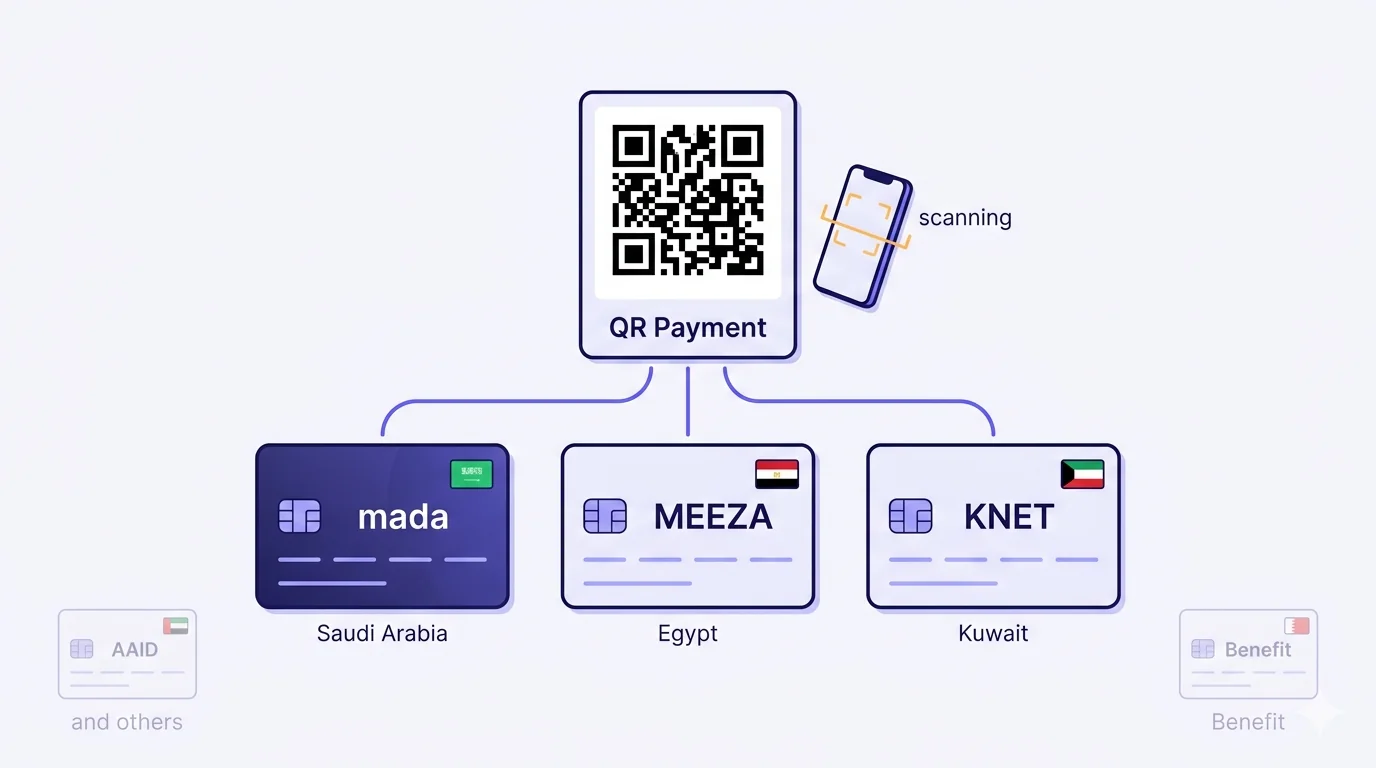
If you accept payments in MENA, the most consequential thing your QR code is doing is not generating a payment — it's choosing a rail. The same scanned QR can settle a SAR 50 transaction in Riyadh through the mada network at one fee structure, an EGP 200 transaction in Cairo through MEEZA at another, a KWD 5 transaction in Kuwait City through KNET at a third — or it can route the same cards through Visa/Mastercard international rails at meaningfully higher cost. The customer doesn't see the difference; you and your processor absolutely do. This is the part of MENA payment QR that almost no English-language guide explains.
This piece is for MENA merchants, e-commerce operators, marketplace builders, payment-gateway integrators, and finance teams trying to understand why payment QR in this region is structurally different from accepting payments in Europe or North America. It is not legal or financial advice — settlement-rule nuances change with regulation, and your acquiring bank and payment processor are the authoritative source for your specific contract terms. But the structural picture is durable, and it's the picture every QR-payment decision in MENA gets made against.
The five MENA payment schemes you should know
mada — Saudi Arabia (SAMA)
mada is the Saudi national payment scheme operated under the Saudi Central Bank (SAMA). It is the default scheme on virtually every Saudi-issued debit card and the cheapest rail for domestic transactions — interchange fees, scheme fees, and settlement costs are all materially lower than running the same card through Visa or Mastercard rails (mada-branded cards typically also carry Visa or Mastercard co-badging for international use, but domestic transactions route through mada by default and by regulation in many cases). Vision 2030's cashless-economy push has made mada-routed QR payments a strategic government priority — mada QR specs are now an official SAMA-published standard, and accepting mada is increasingly table-stakes for any KSA merchant taking digital payments.
MEEZA — Egypt (CBE)
MEEZA is Egypt's national payment card scheme, operated under the Central Bank of Egypt as part of a long-running financial-inclusion strategy. It has been a tool of state-driven account opening — government salaries and pensions are routinely issued on MEEZA cards, expanding the cardholder base from a previously bank-account-light population. MEEZA QR sits atop this infrastructure. For merchants in Egypt accepting QR, MEEZA acceptance is now a meaningful share of card volume — substantially higher than it was three or four years ago — and the per-transaction economics differ from Visa/Mastercard rails on Egyptian-issued cards.
KNET — Kuwait
KNET is Kuwait's national payment switch, operated by the Kuwait Automated Settlement System and predating most modern QR schemes by decades — KNET has been the spine of Kuwaiti domestic card payments since the early 1990s. KNET is the default scheme on Kuwaiti debit cards and is overwhelmingly the rail customers expect at point of sale. KNET QR exists in modern form and is the de facto domestic QR rail for any Kuwaiti merchant — international cards work, but Kuwaiti customers generally prefer paying with their KNET debit card directly, often via NBK Pay or similar mobile wallets that QR-scan into a KNET transaction.
AAID — UAE
The UAE's domestic scheme picture is structurally a little different — historically more Visa/Mastercard-routed than KSA or Egypt — but the Central Bank of the UAE has been building the local infrastructure (instant payment rail, AAID — Aani — instant payment system launched by Al Etihad Payments). UAE QR payment via Aani and via the major banks' QR wallets routes through this domestic infrastructure for instant settlement, often substantially faster and cheaper than card-rail equivalents. For UAE merchants accepting QR, Aani acceptance is increasingly the strategic anchor.
Benefit — Bahrain
Benefit Pay is the Bahraini national payment scheme, operated by BENEFIT Company. Benefit QR is well-established in Bahrain (more so than equivalents in some larger neighbouring markets) — Bahrain's small geographic and population scale let domestic-scheme QR adoption move faster than in larger markets. For any Bahraini merchant, Benefit acceptance is functionally mandatory for serious POS volume.
Other schemes worth mentioning briefly: Jordan's JoMoPay (driven by Central Bank of Jordan), Qatar's QPAY (NAPS-operated), and Morocco's nascent national card-scheme work led by Bank Al-Maghrib. The pattern is consistent — every MENA market is building or has built domestic-scheme rails that route differently from international card networks, and QR payment is increasingly the surface where these rails meet the customer.
Why this matters operationally
Five practical implications that change how MENA merchants should think about QR payment.
1. Settlement cost varies by 100-300 basis points depending on which rail your QR routes
The exact numbers depend on your acquirer contract, your monthly volume, your merchant category code, and your card mix — and they shift over time. But as a structural fact: a mada-routed domestic transaction in KSA, a MEEZA-routed transaction in Egypt, a KNET-routed transaction in Kuwait will typically cost the merchant materially less to settle than the same card running through Visa or Mastercard international rails. If your processor lets you preference domestic-scheme routing where the card supports it, doing so over a year on a few thousand daily transactions adds up. If your processor doesn't expose that control to you, ask your account manager — the answer is sometimes a config flag away.
2. Cardholder experience differs by scheme
On a mada-issued card scanned at a Saudi merchant's QR, the customer's bank may prompt for a different authentication flow (mada SecureCode versus the international 3DS variants), may show the receipt in a slightly different format, and may settle in a different number of business days. Customers know which scheme they're on — most Saudi consumers will explicitly check that a merchant accepts mada before scanning. The same applies in Egypt for MEEZA, Kuwait for KNET, etc. The 'we accept all cards' signage that works in Europe doesn't carry the same trust signal in MENA — 'we accept mada' is the trust-anchor phrase a Saudi consumer is looking for.
3. Recurring/MIT and subscription QR payments have scheme-specific gotchas
If your QR initiates a subscription or a tokenised recurring charge (the customer scans once, future months charge automatically without re-scanning), the scheme matters enormously. Domestic schemes have their own merchant-initiated-transaction (MIT) standards, often more conservative than international card schemes — some require explicit per-charge customer authorisation, some have lower velocity limits, some don't yet support MIT at all for certain card categories. If you're building a subscription product on QR payment, your acquirer needs to confirm which schemes will support tokenised recurring on which card types, in which markets. This is the single largest source of integration friction we see MENA merchants hit when moving from international-scheme-only payments into domestic-scheme acceptance.
4. Refund, chargeback, and dispute flows are scheme-specific
Each domestic scheme runs its own dispute resolution process. mada disputes follow SAMA-aligned timelines and evidence requirements; MEEZA disputes follow CBE-aligned ones; KNET has its own. International-scheme dispute experience does not transfer directly. Your support team handling chargebacks needs to know which scheme each transaction routed through and what that scheme's specific evidence package looks like. The processor usually handles the heavy lifting, but the merchant-side data needs (transaction logs, customer IPs, delivery proofs, signed receipts) varies by scheme.
5. The QR itself doesn't pick the scheme — the card does
An important conceptual clarification: when a customer scans your QR and pays, the QR itself is largely scheme-agnostic. It's a payment-request envelope. The actual scheme is determined by which card the customer's wallet or app presents to settle the transaction. So a single QR can route through mada when scanned by a Saudi consumer with a mada-issued card, through Visa rails when scanned by a Lebanese tourist with a Visa-issued international card, and through MEEZA when scanned by an Egyptian customer with a MEEZA card. Your role as the merchant is to make sure your processor and gateway support all the schemes your customer base actually carries — the QR will adapt.
How a QR-payment flow actually executes in MENA
The full sequence, simplified:
- Customer scans your QR with their banking app (mada app for Saudis with mada-only cards, the same banking-app QR for those with co-badged cards, similar pattern for other markets) or with their general payment wallet (STC Pay, Apple Pay, Google Pay, urpay, NBK Pay, etc.).
- The wallet/app extracts the payment-request envelope from the QR (which encodes your merchant ID, the amount, the currency, an idempotency token, etc.).
- The wallet/app presents the customer's selected payment instrument (a specific card, a wallet balance, or a bank account) to your gateway.
- Your gateway determines the appropriate rail based on the card's scheme — domestic-scheme if available and preferenced, international-scheme otherwise.
- Authorisation goes through that rail; settlement follows the rail's specific timing rules.
- Customer sees a confirmation in their app; your gateway sends a webhook to your backend; your merchant of record reflects the transaction with the rail clearly tagged for reconciliation.
The rail choice happens at step 4 and is largely invisible to both the customer and the merchant. But the cost difference, dispute path, and reconciliation tagging at step 6 are all real and accountable. Your finance team's monthly close should reconcile by rail.
What MENA merchants should ask their payment processor
If you're evaluating a payment processor for QR acceptance in MENA, the questions that actually matter beyond the standard '%-per-transaction' rate:
- Which domestic schemes do you support natively as a default rail (not just as a fallback)? Per market.
- What is the settlement rate (interchange + scheme + acquirer markup) for each domestic scheme vs Visa/Mastercard on the same card type? Get a table by market and card category.
- Do you support tokenised recurring payments on mada? On MEEZA? On KNET? With what limits and on which card categories?
- When a customer scans a co-badged card, which scheme do you preference by default, and is that configurable per merchant?
- Which dispute portals do you front for me? Do I see one unified UI, or does each scheme require a separate workflow?
- What's your typical settlement timing per scheme — T+1, T+2, T+3? Domestic schemes are often faster than international, but this varies.
- Do you generate the QR for me, or do I need to comply with each scheme's QR-format spec (EMV QR Code Specification compatible, mada-aligned, etc.) myself?
Static vs dynamic QR at the payment layer
Payment QRs in MENA — whether mada, MEEZA, KNET, or international-scheme — come in both static and dynamic flavours, but they mean something specific in payments.
Static payment QR: encodes your merchant ID and possibly an account-routing identifier, but no amount. The customer scans, then types the amount manually in their wallet app. Used for small shops, taxis, market stalls. Cheap to deploy (one sticker per shop), but the customer-types-the-amount UX is friction-heavy and error-prone. Best for low-value, customer-initiated transfers.
Dynamic payment QR: encodes the merchant ID AND the specific amount AND a transaction-unique idempotency token, generated by the merchant's POS or app each transaction. The customer scans and confirms a pre-filled amount. This is the cleaner UX and the standard for any serious retail or e-commerce payment QR. Requires either a screen at the POS that can render the QR per transaction, or a printed QR that links to a transaction-specific dynamic URL.
QRA-style dynamic-URL QRs are a separate concept from dynamic-payment QRs and shouldn't be confused: a QRA dynamic QR encodes a redirect URL that the operator can edit anytime (changing where the QR sends the visitor), whereas a dynamic payment QR encodes a per-transaction amount + token generated at sale time. The two layer cleanly — you might use a QRA dynamic QR to point to a payment-checkout page, which then generates a dynamic payment QR for the specific transaction.
Where this fits with QRA + PayTabs
QRA's payment-related QR types are designed to layer on top of MENA-native payment processors — most commonly PayTabs in our customer base, which natively routes mada, MEEZA, KNET, and several international schemes through KSA-resident infrastructure. The QR carries a stable URL to your payment checkout; the checkout displays the per-transaction dynamic payment QR that the customer's wallet actually scans; the wallet routes through the appropriate domestic scheme based on the card presented. You get the routing optimisation, your customer gets the familiar wallet experience, and you keep the option to update the underlying payment URL or routing anytime without reprinting the QR.
The short answer
MENA payment QR is not just international cards on a different surface. mada, MEEZA, KNET, AAID/Aani, Benefit, and the parallel schemes in other markets route domestic transactions through national-scheme infrastructure with different cost, different settlement, different dispute flow, and different recurring-payment behaviour from Visa/Mastercard international rails. The customer scanning your QR is choosing a rail when they choose a card. Your processor should let you preference the domestic-scheme rail where it's available; your finance team should reconcile by rail; your dispute team should be ready for scheme-specific evidence requirements. Treat domestic-scheme support as table-stakes for MENA, not as a nice-to-have.
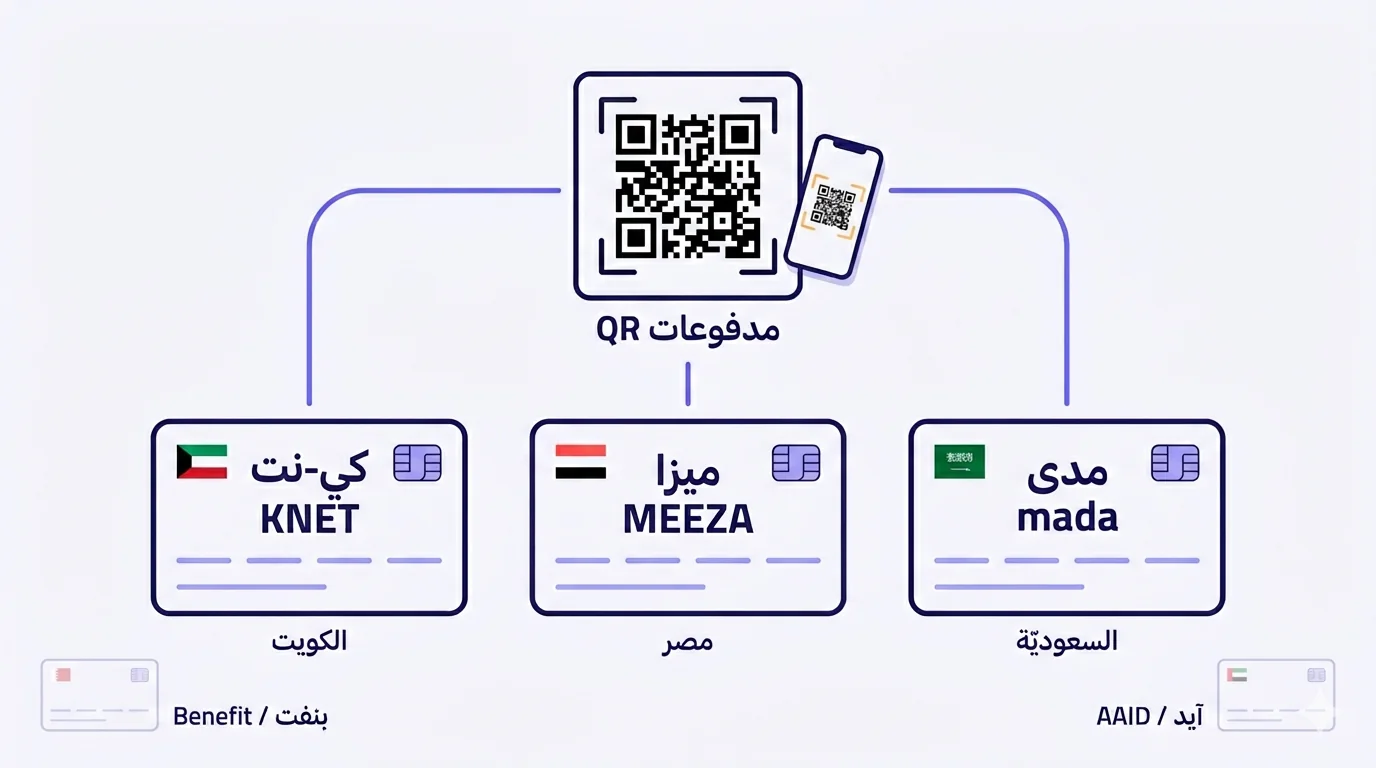
إن كنت تقبل مدفوعات في الشرق الأوسط، فالشيء الأهمّ الذي يقوم به رمز QR الخاصّ بك ليس توليد دفعة — بل اختيار قضيب. الرمز نفسه حين يُمسح يمكن أن يسوّي معاملة بـ ٥٠ ريال سعودي في الرياض عبر شبكة مدى بهيكل رسوم معيّن، ومعاملة بـ ٢٠٠ جنيه مصري في القاهرة عبر ميزا بآخر، ومعاملة بـ ٥ دنانير كويتيّة في مدينة الكويت عبر كي-نت بهيكل ثالث — أو يستطيع توجيه البطاقات نفسها عبر قضبان فيزا/ماستركارد الدوليّة بتكلفة أعلى بشكل ملموس. لا يرى العميل الفرق؛ أمّا أنت ومعالج الدفع لديك فترَيانه قطعاً. هذا هو الجزء من مدفوعات QR في الشرق الأوسط الذي لا يشرحه تقريباً أيّ دليل باللغة الإنجليزيّة.
هذا المقال موجَّه لتجّار الشرق الأوسط، ومشغّلي التجارة الإلكترونيّة، وبُناة الأسواق، ومُدمجي بوّابات الدفع، وفرق المالية الذين يحاولون فهم لماذا تختلف مدفوعات QR في هذه المنطقة هيكليّاً عن قبول المدفوعات في أوروبا أو أمريكا الشمالية. ليس استشارة قانونيّة أو ماليّة — تفاصيل قواعد التسوية تتغيّر مع التشريع، والبنك المُكتسِب ومعالج الدفع لديك هما المصدر المرجعي لشروط عقدك المحدّدة. لكنّ الصورة الهيكليّة دائمة، وهي الصورة التي تُتَّخذ في ضوئها كلّ قرارات دفع QR في الشرق الأوسط.
أنظمة الدفع الخمسة في الشرق الأوسط التي يجب أن تعرفها
مدى — السعوديّة (مؤسّسة النقد العربي السعودي)
مدى هو نظام الدفع الوطني السعودي الذي يعمل تحت إشراف البنك المركزي السعودي (ساما). إنّه النظام الافتراضي على كلّ بطاقة خصم تقريباً تُصدرها بنوك سعوديّة وأرخص قضيب للمعاملات المحلّيّة — رسوم التداول، ورسوم النظام، وتكاليف التسوية كلّها أقلّ بشكل ملموس من تشغيل البطاقة نفسها عبر قضبان فيزا أو ماستركارد (بطاقات مدى تحمل عادةً علامة مزدوجة فيزا أو ماستركارد للاستخدام الدولي، لكنّ المعاملات المحلّيّة تُوجَّه عبر مدى افتراضيّاً وبموجب التشريع في كثير من الحالات). دفع رؤية ٢٠٣٠ نحو اقتصاد بلا نقد جعل مدفوعات QR الموجَّهة عبر مدى أولويّة حكوميّة استراتيجيّة — مواصفات QR مدى أصبحت الآن معياراً رسميّاً تنشره ساما، وقبول مدى أصبح بشكل متزايد شرطاً أساسيّاً لأيّ تاجر سعودي يقبل المدفوعات الرقميّة.
ميزا — مصر (البنك المركزي المصري)
ميزا هو نظام بطاقات الدفع الوطني في مصر، الذي يعمل تحت إشراف البنك المركزي المصري كجزء من استراتيجيّة شموليّة ماليّة طويلة المدى. كان أداةً لفتح الحسابات بدفع من الدولة — تُصرف رواتب الحكومة والمعاشات بشكل اعتيادي على بطاقات ميزا، فتوسّع قاعدة حاملي البطاقات من سكّان كانوا سابقاً قليلي الحساب البنكي. ويستقرّ QR ميزا فوق هذه البنية التحتيّة. لتجّار مصر الذين يقبلون QR، أصبح قبول ميزا الآن حصّةً ملموسةً من حجم البطاقات — أعلى بكثير ممّا كان عليه قبل ثلاث أو أربع سنوات — واقتصاديّات المعاملة تختلف عن قضبان فيزا/ماستركارد على البطاقات المصريّة الإصدار.
كي-نت — الكويت
كي-نت هو محوّل الدفع الوطني في الكويت، الذي يعمل عبر نظام التسوية الآلي الكويتي، ويسبق معظم أنظمة QR الحديثة بعقود — كي-نت هو العمود الفقري لمدفوعات البطاقات المحلّيّة في الكويت منذ أوائل التسعينيّات. هو النظام الافتراضي على بطاقات الخصم الكويتيّة وهو القضيب الذي يتوقّعه العملاء بشكل ساحق عند نقطة البيع. كي-نت QR موجود بصيغته الحديثة وهو فعليّاً قضيب QR المحلّي لأيّ تاجر كويتي — البطاقات الدوليّة تعمل، لكنّ العملاء الكويتيين يفضّلون عموماً الدفع ببطاقة الخصم الكي-نت مباشرةً، غالباً عبر NBK Pay أو محافظ مماثلة تمسح QR لتتحوّل إلى معاملة كي-نت.
آيد — الإمارات
صورة النظام المحلّي في الإمارات مختلفة هيكليّاً قليلاً — تاريخيّاً أكثر توجيهاً عبر فيزا/ماستركارد من السعوديّة أو مصر — لكنّ مصرف الإمارات العربيّة المتّحدة المركزي يبني البنية التحتيّة المحلّيّة (قضيب الدفع الفوري، آيد — نظام عاني للدفع الفوري الذي أطلقته الاتّحاد للمدفوعات). تذهب مدفوعات QR الإماراتيّة عبر عاني ومحافظ QR للبنوك الكبرى عبر هذه البنية المحلّيّة للتسوية الفوريّة، غالباً أسرع وأرخص بشكل ملموس من معادلاتها على قضيب البطاقات. للتجّار الإماراتيين الذين يقبلون QR، أصبح قبول عاني المرسى الاستراتيجي بشكل متزايد.
بنفت — البحرين
Benefit Pay هو نظام الدفع الوطني البحريني، الذي تشغّله شركة BENEFIT. بنفت QR راسخ في البحرين (أكثر من معادلاته في بعض الأسواق المجاورة الأكبر) — السلم الجغرافي والسكّاني الصغير للبحرين سمح لانتشار QR المحلّي بالتحرّك أسرع من الأسواق الأكبر. لأيّ تاجر بحريني، قبول بنفت إلزامي وظيفيّاً لحجم نقطة بيع جدّي.
أنظمة أخرى تستحقّ الذكر باختصار: JoMoPay الأردنيّة (بقيادة البنك المركزي الأردني)، QPAY القطريّة (تشغيل NAPS)، وعمل نظام البطاقات الوطني المغربي الناشئ بقيادة بنك المغرب. النمط ثابت — كلّ سوق في الشرق الأوسط يبني أو بنى قضباناً محلّيّة توجّه بشكل مختلف عن شبكات البطاقات الدوليّة، ومدفوعات QR أصبحت بشكل متزايد السطح الذي تلتقي فيه هذه القضبان بالعميل.
لماذا يهمّ هذا تشغيليّاً
خمسة آثار عمليّة تغيّر كيف يجب أن يفكّر تجّار الشرق الأوسط في مدفوعات QR.
١. تكلفة التسوية تتفاوت بـ ١٠٠-٣٠٠ نقطة أساس بحسب القضيب الذي يوجّه إليه QR
الأرقام الدقيقة تعتمد على عقد المُكتسِب لديك، حجم شهرك، رمز فئة التاجر، ومزيج البطاقات — وتتغيّر مع الزمن. لكن كحقيقة هيكليّة: معاملة محلّيّة موجَّهة عبر مدى في السعوديّة، أو معاملة موجَّهة عبر ميزا في مصر، أو معاملة موجَّهة عبر كي-نت في الكويت، ستكلّف التاجر عادةً تسويتها أقلّ بشكل ملموس من البطاقة نفسها التي تمرّ عبر قضبان فيزا أو ماستركارد الدوليّة. إن سمح لك معالجك بتفضيل التوجيه عبر النظام المحلّي حين تدعمه البطاقة، فالقيام بذلك على بضعة آلاف معاملة يوميّة عبر سنة يتراكم. إن لم يكشف لك معالجك عن هذا التحكّم، اسأل مدير حسابك — الجواب أحياناً علامة إعداد واحدة بعيدة.
٢. تجربة حامل البطاقة تختلف بحسب النظام
على بطاقة مُصدَرة عبر مدى يُمسح بها QR لتاجر سعودي، قد يطلب بنك العميل تدفّق توثيق مختلف (مدى SecureCode مقابل أصناف 3DS الدوليّة)، وقد يعرض الإيصال بصيغة مختلفة قليلاً، وقد يسوّي خلال عدد مختلف من أيّام العمل. العملاء يعرفون أيّ نظام هم عليه — معظم المستهلكين السعوديين يتحقّقون صراحةً من أنّ التاجر يقبل مدى قبل المسح. الأمر نفسه ينطبق في مصر لميزا، في الكويت لكي-نت، إلخ. لافتة «نقبل جميع البطاقات» التي تعمل في أوروبا لا تحمل الإشارة الموثوقة نفسها في الشرق الأوسط — «نقبل مدى» هي العبارة المرجع التي يبحث عنها المستهلك السعودي.
٣. مدفوعات QR المتكرّرة والاشتراكات بـ MIT لها فخاخ خاصّة بالنظام
إن بدأ QR لديك اشتراكاً أو رسماً متكرّراً مرمزاً (يمسح العميل مرّة، وتُحَصَّل الأشهر القادمة تلقائيّاً دون إعادة المسح)، فالنظام يهمّ بشكل هائل. الأنظمة المحلّيّة لها معاييرها الخاصّة للمعاملات التي يبدأها التاجر (MIT)، غالباً أكثر تحفّظاً من أنظمة البطاقات الدوليّة — بعضها يتطلّب تخويل العميل صراحةً لكلّ تحصيل، بعضها يفرض حدود سرعة أقلّ، بعضها لا يدعم MIT بعد لفئات بطاقات معيّنة. إن كنت تبني منتج اشتراكات على مدفوعات QR، فيجب على مُكتسِبك تأكيد أيّ الأنظمة تدعم التكرار المرمز على أيّ أنواع بطاقات، في أيّ أسواق. هذا أكبر مصدر احتكاك تكاملي نراه يصطدم به تجّار الشرق الأوسط حين ينتقلون من مدفوعات الأنظمة الدوليّة فقط إلى قبول الأنظمة المحلّيّة.
٤. تدفّقات الاسترداد والمحاسبة والنزاعات خاصّة بالنظام
كلّ نظام محلّي يدير عمليّة حلّ نزاع خاصّة به. نزاعات مدى تتبع جداول زمنيّة ومتطلّبات أدلّة متوائمة مع ساما؛ نزاعات ميزا تتبع متوائمة مع البنك المركزي المصري؛ كي-نت له خاصّته. خبرة نزاع النظام الدولي لا تنتقل مباشرةً. فريق الدعم لديك الذي يتعامل مع المحاسبة يحتاج إلى معرفة أيّ نظام وجّهت إليه كلّ معاملة وكيف تبدو حزمة أدلّة ذلك النظام تحديداً. عادةً يتعامل المعالج مع الرفع الثقيل، لكنّ بيانات جانب التاجر المطلوبة (سجلّات المعاملات، عناوين IP للعملاء، أدلّة التسليم، الإيصالات الموقّعة) تتفاوت بحسب النظام.
٥. QR نفسه لا يختار النظام — البطاقة هي التي تختار
توضيح مفاهيمي مهمّ: حين يمسح عميل QR لديك ويدفع، فإنّ QR نفسه إلى حدّ بعيد محايد للنظام. هو مغلّف طلب دفع. النظام الفعلي يُحدَّد بأيّ بطاقة تقدّمها محفظة العميل أو تطبيقه لتسوية المعاملة. لذا يمكن لرمز QR واحد أن يوجَّه عبر مدى حين يُمسح من قِبَل مستهلك سعودي ببطاقة مُصدَرة عبر مدى، عبر قضبان فيزا حين يُمسح من قِبَل سائح لبناني ببطاقة دوليّة مُصدَرة عبر فيزا، وعبر ميزا حين يُمسح من قِبَل عميل مصري ببطاقة ميزا. دورك كتاجر هو ضمان أنّ معالجك وبوّابتك يدعمان كلّ الأنظمة التي تحملها قاعدة عملائك فعلاً — QR سيتكيّف.
كيف يُنفَّذ تدفّق دفع QR فعليّاً في الشرق الأوسط
التسلسل الكامل، مبسّطاً:
- العميل يمسح QR لديك بتطبيقه البنكي (تطبيق مدى للسعوديين ببطاقات مدى-فقط، QR التطبيق البنكي نفسه لمن لديهم بطاقات بعلامة مزدوجة، نمط مشابه للأسواق الأخرى) أو بمحفظة الدفع العامّة لديه (STC Pay، Apple Pay، Google Pay، يور باي، NBK Pay، إلخ).
- تستخرج المحفظة/التطبيق مغلّف طلب الدفع من QR (الذي يرمز معرّف التاجر، المبلغ، العملة، رمز التفرّد، إلخ).
- تقدّم المحفظة/التطبيق أداة الدفع المختارة للعميل (بطاقة محدّدة، رصيد محفظة، أو حساب بنكي) لبوّابتك.
- تحدّد بوّابتك القضيب المناسب بناءً على نظام البطاقة — النظام المحلّي إن كان متاحاً ومفضّلاً، النظام الدولي وإلّا.
- يمرّ التخويل عبر ذلك القضيب؛ التسوية تتبع قواعد توقيت القضيب المحدّدة.
- يرى العميل تأكيداً في تطبيقه؛ ترسل بوّابتك ويب هوك إلى خلفيّتك؛ يعكس تاجر السجلّ المعاملة مع وسم القضيب بوضوح للتسوية.
اختيار القضيب يحدث في الخطوة ٤ وهو في الغالب غير مرئي للعميل والتاجر. لكن فرق التكلفة، ومسار النزاع، ووسم التسوية في الخطوة ٦ كلّها حقيقيّة وقابلة للمساءلة. إقفال شهر فريق ماليّتك يجب أن يسوّي بحسب القضيب.
ما يجب على تجّار الشرق الأوسط أن يسألوه لمعالج الدفع لديهم
إن كنت تقيّم معالج دفع لقبول QR في الشرق الأوسط، الأسئلة التي تهمّ فعلاً بعد معدّل «النسبة-لكلّ-معاملة» القياسي:
- أيّ أنظمة محلّيّة تدعمها أصليّاً كقضيب افتراضي (لا فقط كنسخة احتياطيّة)؟ لكلّ سوق.
- ما هو معدّل التسوية (التداول + النظام + هامش المُكتسِب) لكلّ نظام محلّي مقابل فيزا/ماستركارد على نوع البطاقة نفسه؟ احصل على جدول بحسب السوق وفئة البطاقة.
- هل تدعم المدفوعات المتكرّرة المرمزة على مدى؟ على ميزا؟ على كي-نت؟ بأيّ حدود وعلى أيّ فئات بطاقات؟
- حين يمسح عميل بطاقة بعلامة مزدوجة، أيّ نظام تفضّله افتراضيّاً، وهل ذلك قابل للضبط لكلّ تاجر؟
- أيّ بوّابات نزاع تواجهها لي؟ هل أرى واجهة موحّدة، أم يتطلّب كلّ نظام تدفّق عمل منفصلاً؟
- ما توقيت التسوية المعتاد لديك لكلّ نظام — T+1، T+2، T+3؟ الأنظمة المحلّيّة غالباً أسرع من الدوليّة، لكنّ هذا يتفاوت.
- هل تولّد QR لي، أم أحتاج إلى الامتثال لمواصفات صيغة QR لكلّ نظام (متوافق مع مواصفات EMV QR Code، متوائم مع مدى، إلخ) بنفسي؟
الثابت مقابل الديناميكي على طبقة الدفع
مدفوعات QR في الشرق الأوسط — سواء مدى، ميزا، كي-نت، أو نظام دولي — تأتي بأنواع ثابتة وديناميكيّة، لكنّها تعني شيئاً محدّداً في المدفوعات.
QR دفع ثابت: يرمز معرّف تاجرك وربّما معرّف توجيه حساب، لكن لا مبلغ. يمسح العميل، ثمّ يكتب المبلغ يدويّاً في تطبيق محفظته. يُستخدم للمحلّات الصغيرة، سيّارات الأجرة، أكشاك السوق. رخيص في النشر (ملصق واحد لكلّ محلّ)، لكن تجربة كتابة-العميل-للمبلغ كثيرة الاحتكاك وعرضة للأخطاء. الأنسب للتحويلات الصغيرة القيمة التي يبدأها العميل.
QR دفع ديناميكي: يرمز معرّف التاجر والمبلغ المحدّد ورمز تفرّد فريد للمعاملة، يولّده نظام نقطة بيع التاجر أو تطبيقه لكلّ معاملة. يمسح العميل ويؤكّد مبلغاً مُعدّاً مسبقاً. هذه تجربة أنظف ومعيار لأيّ دفع QR جدّي للتجزئة أو التجارة الإلكترونيّة. يتطلّب إمّا شاشة عند نقطة البيع تستطيع عرض QR لكلّ معاملة، أو QR مطبوع يحيل إلى رابط ديناميكي خاصّ بالمعاملة.
رموز QR ديناميكيّة-الرابط من نوع QRA مفهوم منفصل عن رموز QR الدفع الديناميكيّة ولا يجب الخلط بينهما: رمز QRA الديناميكي يرمز رابط إعادة توجيه يستطيع المشغّل تعديله متى شاء (تغيير حيث يرسل الرمز الزائر)، بينما QR الدفع الديناميكي يرمز مبلغاً + رمز فريد لكلّ معاملة يُولَّد وقت البيع. الاثنان يتراصّان بنظافة — يمكنك استخدام QR ديناميكي من QRA يشير إلى صفحة دفع، تولّد بعد ذلك QR دفع ديناميكي للمعاملة المحدّدة.
أين يتناسب هذا مع QRA + PayTabs
أنواع QR المرتبطة بالمدفوعات في QRA مصمّمة لتترامى فوق معالجات دفع الشرق الأوسط الأصليّة — أكثرها شيوعاً PayTabs في قاعدة عملائنا، التي توجّه أصليّاً مدى وميزا وكي-نت وعدّة أنظمة دوليّة عبر بنية تحتيّة مقيمة في المملكة. يحمل QR رابطاً ثابتاً لصفحة دفعك؛ تعرض الصفحة QR الدفع الديناميكي الخاصّ بالمعاملة الذي تمسحه محفظة العميل فعلاً؛ توجّه المحفظة عبر النظام المحلّي المناسب بناءً على البطاقة المقدّمة. تحصل على تحسين التوجيه، وعميلك يحصل على تجربة محفظة مألوفة، وتحتفظ بخيار تحديث رابط الدفع الأساسي أو التوجيه في أيّ وقت دون إعادة طباعة QR.
الإجابة المختصرة
مدفوعات QR في الشرق الأوسط ليست مجرّد بطاقات دوليّة على سطح مختلف. مدى، وميزا، وكي-نت، وآيد/عاني، وبنفت، والأنظمة المتوازية في الأسواق الأخرى توجّه المعاملات المحلّيّة عبر بنية تحتيّة النظام الوطني بتكلفة مختلفة، تسوية مختلفة، تدفّق نزاع مختلف، وسلوك مدفوعات متكرّرة مختلف عن قضبان فيزا/ماستركارد الدوليّة. العميل الذي يمسح QR لديك يختار قضيباً حين يختار بطاقة. يجب أن يسمح لك معالجك بتفضيل قضيب النظام المحلّي حين يكون متاحاً؛ وفريق ماليّتك يجب أن يسوّي بحسب القضيب؛ وفريق النزاع يجب أن يكون جاهزاً لمتطلّبات أدلّة خاصّة بالنظام. تعامل مع دعم النظام المحلّي كشرط أساسي للشرق الأوسط، لا كأمر مرغوب فيه.
Ready to make a smarter QR?جاهز لإنشاء رمز QR أذكى؟
Sign up free — no card needed. Track every scan, edit destinations anytime.سجّل مجاناً — بدون بطاقة. تتبّع كل عملية مسح وعدّل الوجهة في أي وقت.